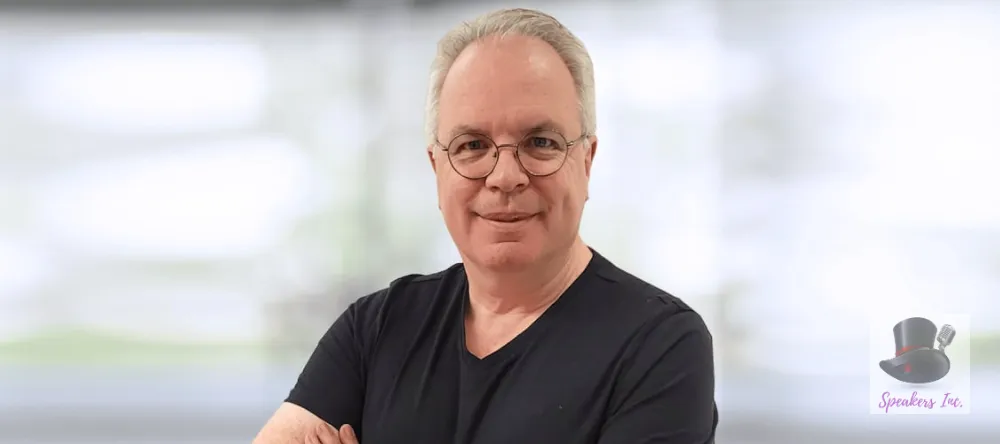

Laurence Moroney is a globally recognized thought leader in artificial intelligence and machine learning, best known as Google’s former Lead AI Advocate. With a career spanning Vicon Industries, Reuters, Mainsoft, Microsoft, and Google, Laurence bridges deep technical expertise with clear, practical communication. He holds a BSc in Physics and Computer Science, a Postgraduate Diploma in Microelectronics Systems Design, and a Graduate Certificate in Artificial Intelligence from Stanford University.
As a bestselling author (AI and Machine Learning for Coders, The Definitive Guide to Firebase), Laurence is committed to demystifying AI and making it accessible across industries. He is also a prominent educator, with courses on Coursera, edX, and Udacity, reaching hundreds of thousands of learners worldwide. Through dynamic keynotes, workshops, and training, Laurence equips organizations to harness AI responsibly, strategically, and effectively.
Laurence Moroney is a globally recognized authority on artificial intelligence and machine learning. As the former Lead AI Advocate at Google, Laurence brings unparalleled insight into the evolving AI landscape. His mission is clear: to demystify AI and make it accessible across industries.
Laurence holds a BSc in Physics and Computer Science and a Postgraduate Diploma in Microelectronics Systems Design. His journey spans pivotal roles at Vicon Industries, Reuters, Mainsoft, Microsoft, and Google. Notably, his transition into AI was solidified by a Graduate Certificate in Artificial Intelligence from Stanford University.
Today, Laurence empowers audiences worldwide through high-impact keynotes and educational platforms like Coursera, edX, and Udacity, all while continuing his advocacy through bestselling books such as “AI and Machine Learning for Coders” and “The Definitive Guide to Firebase.”
Why Book Laurence Moroney?
Laurence doesn’t just talk AI, he’s helped shape it at some of the world’s most influential tech companies. With a rare blend of technical depth and engaging delivery, he ensures your audience walks away informed, empowered, and ready to lead in the age of AI.
“For organizations looking to not just understand but lead the AI revolution, Laurence Moroney is the speaker to make it happen.”
View further Artificial Intelligence speakers and follow us on LinkedIn
Laurence Moroney explores how generative AI, especially transformers, can shift from "artificial intelligence" to "artificial understanding" and help preserve cultural heritage.
Laurence Moroney begins with a life lesson from his math teacher: true understanding means you don’t need to memorize.
He connects this to AI today, where the real value isn’t just generating content, but understanding it. He warns that smaller cultures risk being lost in the digital noise, just as ancient Irish culture was erased by invasions and lack of records.
Key insights:
He closes with optimism: 2023 marks the moment we gained the tools to preserve human culture cheaply, quickly, and accessibly—a chance for developers everywhere to shape legacy.
0:00 – Lesson from math teacher: true understanding removes need for memorization.
1:30 – Writing his first novel: searching for cultural connections across Ireland, China, and the US.
2:30 – Problem of history: small cultures lost their records; today, small voices risk being drowned by digital noise (bots, oversaturation).
4:15 – Generative AI isn’t about creation — it’s about understanding content.
5:30 – Transformers explained: from literal translation (“The raven loves its chicks”) to sentiment-based translation (“Beauty is in the eye of the beholder”).
7:00 – Reframing AI as “artificial understanding.”
8:15 – Efficiency & compression: GPT’s 200B parameters vs. Gemini Nano’s 100M. Models can now fit on phones.
10:00 – Specialized models: curating cultural datasets (e.g., Irish stew recipes) creates lasting digital cultural memory.
11:45 – The future: interactive, small-footprint models on phones/laptops enabling cultural learning without internet.
13:15 – Call to action: 2023 is the inflection point where developers can preserve cultures affordably and collaboratively.
Laurence Moroney breaks down AI, ML, models, deployment, and MLOps for developers starting their AI journey.
Laurence Moroney introduces the AI & ML Developer Journey, guiding beginners and developers through the fundamentals of artificial intelligence and how machine learning makes it real.
Key concepts include:
The session emphasizes that while AI is complex, Google’s ecosystem of tools, hardware, and frameworks (TensorFlow, Keras, TPUs, Cloud services) makes it accessible for developers worldwide.
0:00 – Introduction: AI & ML terms can be overwhelming — where do developers start?
0:45 – What is AI? Computers reacting to data like intelligent beings (example: recognizing a cat).
2:00 – What is ML? Training computers with data examples to distinguish between categories (cats, dogs, horses).
3:00 – What are models? Mathematical functions that take input data and produce predictions.
4:00 – The ML process: starts with data engineering (cleansing, processing, spotting bias).
5:15 – Modeling: Frameworks like TensorFlow & Keras simplify complex ML architectures (transformers, CNNs).
6:00 – Training → Deploying models across devices, cloud, or web.
7:00 – Developers’ role: integrating models with platforms (e.g., Android apps).
7:45 – Deployment isn’t the end — monitoring and improving models is key (MLOps).
8:30 – Accelerated infrastructure: GPUs for fast math, TPUs optimized for ML workloads.
9:15 – Responsible AI: ethical use and tools for fairness, transparency, and safety.
10:15 – Resources: YouTube playlists, online courses, samples to kickstart your ML journey.
11:00 – Closing: AI is complex but achievable; welcome to the global ML ecosystem.
How Google’s ML tools, frameworks, and hardware accelerate state-of-the-art AI research
Laurence Moroney, Google’s lead for AI & ML advocacy, introduces the Google ML ecosystem and how it supports cutting-edge AI research.
The session reinforces Google’s mission: to make state-of-the-art AI tools and infrastructure accessible, scalable, and open-source.
0:15 – Intro: Google ML ecosystem and advocacy.
0:40 – Google TPUs: hardware designed for ML workloads.
1:20 – TPU Pods: AI supercomputers for large-scale training.
1:45 – Research example: chip floor planning with deep RL.
2:05 – T5X framework: modular system for training/evaluating sequence models.
2:30 – Example: 11B+ parameter language model trained on massive dataset.
3:05 – TPU Research Cloud: free TPU access for researchers globally.
3:45 – Pathdreamer: AI project for indoor navigation, generating unseen 360° views.
4:50 – Built with TensorFlow & Keras, fully open-sourced.
5:25 – JAX: high-performance numerical computing with Python + NumPy.
5:55 – JAX code runs seamlessly on GPUs/TPUs.
6:15 – JAX-TensorFlow compatibility for data pipelines.
6:40 – Closing: invitation to learn more in “JAX: Accelerating ML Research.”
No reviews available for this post.
Speaker fees can vary depending on factors such as expertise, demand, and event specifics. While some speakers may charge a flat fee for their services, others may have hourly rates. It’s best to discuss fee structures directly with the speaker or their representative to understand the pricing model.
Keynote speeches typically range from 30 to 90 minutes, with the duration determined by the speaker’s expertise, the event’s agenda, and audience preferences. Keynote speeches often include a combination of inspirational stories, practical insights, and actionable advice tailored to the event’s theme or objectives.
The scale of the event and audience size can indeed impact a speaker’s fee. Larger events with a broader reach or higher attendance may command higher fees due to increased exposure and demand. Conversely, smaller events or niche audiences may offer opportunities for more flexible pricing arrangements.
Travel expenses such as transportation, accommodation, and meals are typically negotiated separately from the speaker’s fee. These costs vary depending on the speaker’s location, travel distance, and event duration. It’s important to clarify travel arrangements and expenses during the booking process to avoid misunderstandings.
Many speakers require a deposit to secure a booking, with the remaining balance due closer to the event date. Deposits are often non-refundable and serve as a commitment from both parties. It’s advisable to discuss deposit requirements and payment terms with the speaker or their representative when finalizing the booking.
Ready to find the perfect speaker for your event? Use our advanced search feature or contact us to get started today!
Kay Firth-Butterfield is an expert in artificial intelligence (AI) ethics and governance, championing the responsible development and deployment of technology. As the CEO of Good Tech Advisory LLC, she leverages her extensive legal and academic background to guide organizations toward ethical AI practices. Her leadership in this domain earned her a spot among TIME’s 100 […]
Anima Anandkumar is Bren Professor at Caltech. She previously was a Senior Director of AI Research at NVIDIA and Principal Scientist at Amazon Web Services. She received her B.Tech from the Indian Institute of Technology Madras, and her Ph.D. from Cornell University. She did her postdoctoral research at MIT and an assistant professorship at the […]
Long before artificial intelligence became the powerhouse of modern technology, Yejin Choi was already diving into its most complex and overlooked challenges. As the Dieter Schwarz Foundation HAI Professor, a Professor of Computer Science, and a Senior Fellow at Stanford HAI, she continues to shape the future of AI research with a sharp focus on […]
John Winsor is a globally recognized leader in the future of work and AI-driven workforce strategies. Recently appointed as an Executive Fellow at Harvard Business School’s Digital, Design, and Data Institute, he focuses on the evolving intersection of work, technology, and talent. John is dedicated to empowering leaders to confidently navigate digital disruption and harness […]
Michelle Lee is a trailblazing AI keynote speaker, renowned technology strategist, and leadership expert who is shaping the future of artificial intelligence and digital transformation. As the founder and CEO of Obsidian Strategies, she has carved out a niche in guiding organizations through the complexities of AI adoption, ethical implementation, and future-ready leadership. With a […]
Dr. Vivienne Ming stands at the intersection of science, technology, and human potential. As a theoretical neuroscientist, delusional inventor, and demented author, she has dedicated her career to exploring how cutting-edge advancements can unlock and maximize human capacity. With a reputation for being one of the most innovative and thought-provoking speakers of our time, Dr. […]
Lital Marom challenges current and future leaders to develop a bolder vision for human potential. She believes that from human potential springs business potential, and it should be used to create a more sustainable, inclusive future. Lital Marom got her start building computer systems for companies in Israel and Europe, before advancing to lead global […]
Hemant Taneja is the CEO of General Catalyst, and a founder, investor, and author of four books, including The Transformation Principles (2025). His vision for General Catalyst (GC) is to be the world’s foremost technology investment company, supporting global resilience through applied AI. I first laid out his AI thesis in the 2018 book Unscaled, […]
No results available
These remain the property of its owner and are not affiliated with or endorsed by Speakers Inc.
All talent fees exclude VAT, travel and accommodation where required.
Our Mission:
© All rights reserved 2026. Designed using Voxel