
Stop the Cycle | Michelle “Mace” Curran
- Author: Michelle Mace Curran
Read the news article
A common problem new pilots struggle with is avoiding a PIO or pilot-induced oscillation. So how do we Stop the Cycle as We’re all familiar with the concept of overcorrecting in a car. A deer runs out, you’re driving tired, you’re near the edge of the road, and you yank the wheel the other direction just to end up in the opposite ditch.
In an aircraft, we have control and performance instruments. The PIO comes into play when the pilot chases the output they want on the performance instrument (altitude, airspeed, heading) by making erratic and too large corrections on the controls instruments (rpm, fuel flow, attitude).
For example, I’m 100′ above my target altitude, so I push the nose of the aircraft down to descend. However, the correction I put in was too large or left in for too long, and now I pass my target altitude and find myself below it and needing to climb back up. As a new pilot, this can be a very frustrating struggle and makes you feel like you’re always a step behind. That’s because you are. You are chasing a result rather than making a small change, being patient, and assessing.
One of the most challenging places to avoid a PIO is when you’re flying formation. Now you aren’t just chasing an airspeed and altitude target, but an exact position relative to another aircraft that is also constantly moving in three dimensions. When I was new to the Thunderbirds, I had already been flying the F-16 for eight years. However, the type of flying you do on the team is much different from anywhere else in the Air Force. I found myself in PIOs regularly during those first few months of training.
Our natural reaction in this situation is to let the stress build and to try even harder to fix the problem. I would find my arm going numb because I was gripping the stick so hard, even though in the F-16, it only moves ¼”. Trying to fly precisely while you’re sweating bullets, irritated with your lack of proficiency, and with a numb hand that feels like it doesn’t belong to you is challenging to say the least. The harder I would try to control the aircraft, the more my arm would turn into a cement block and the more frustrated I would become.
Stop the Cycle | Michelle “Mace” Curran
In your business, it is easy to also find yourself in a PIO, letting one negative experience cause you to sabotage future interactions and pull your organization from one extreme to the other. For example, you get feedback that a customer is unhappy. You change company policy as a result, only to find a few months later, that there are second and third-order negative effects you didn’t anticipate. You had a bad experience with an employee that had a few very apparent personality traits. In response, you only hire people opposite of this bad actor. A year later, you find your team suffering from groupthink and lacking diversity.
So how do we prevent finding ourselves fighting a PIO?
See something that needs correcting? First, stop it from trending in the wrong direction. Maybe that is enough. Sometimes you only need to remove an input without adding one to counteract it. Need more? Make a slight adjustment then be patient. Pause… see what it gives you, what change in performance you gradually get, then adjust further if needed. Over time you develop rules of thumb, so you know exactly how much input you need and when you need to take the adjustments out to land right on the performance you’re targeting, but this will take patience and practice.
Finally, I want to share something I was told when I first learned to air refuel. Getting airborne gas is just another form of flying formation, but your aircraft is touching the other plane this time. To hook up to the refueling boom and stay there, you must make exact adjustments in your position. This is another challenging skill and one that commonly results in over corrections and the dreaded PIO. The advice I had been given when learning to do this for the first time?
Don’t forget to wiggle your toes.
This simple shift of focus allows you to breathe, relax your arm, and loosen your grip. Suddenly, the PIO stops, and you can maintain your position. Sometimes you have to accept what is in your control and what isn’t, wiggle your toes, and relax your grip.
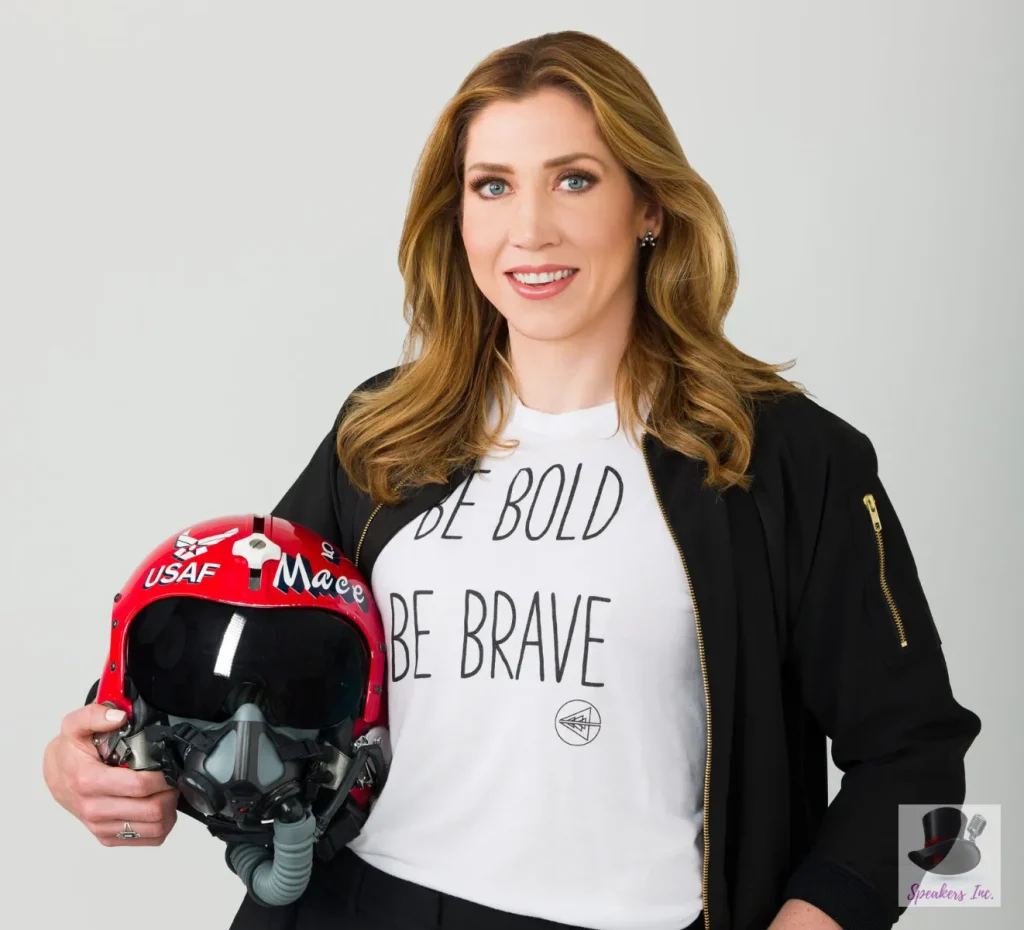
Article originally posted to LinkedIn by Michelle “Mace” Curran. I deliver stories and lessons that you can use from my time as a Fighter Pilot and Thunderbird.
Michelle “MACE” Curran
Looking to book this speaker for your next event?
At Speakers Inc., we connect you with the perfect speaker for your audience.
👉 Contact our team to check availability and secure your speaker
https://speakersinc.com/contact-us/speakers-inc/
👉 Watch more speaker videos on YouTube
https://www.youtube.com/@speakersincUSA/
Speaker Listing
No results available
Further articles you may enjoy:

- (17)
How to Find a Motivational Speaker for Your Employee Engagement Event Employee disengagement is not a morale problem. It is a revenue problem. Gallup’s 2025 State of the Global Workplace report found that only 21% of employees worldwide are engaged at work, a drop from 23% the previous year. In the United States alone, that […]
- September 3, 2026

- (28)
The Most In-Demand Keynote Speaker Topics for 2026 (And What They Mean for Your Event) Corporate event planners are facing a different booking landscape in 2026. Audiences are sharper, more skeptical, and less patient with speakers who deliver polished performances without real substance. Boards want keynotes that move strategy. Attendees want talks that help them […]
- September 2, 2026

- (22)
Best Motivational Speakers for a Nonprofit Annual Gala (and How to Choose the Right One) The keynote speaker at a nonprofit gala is not just a line item on the run-of-show. They are the emotional turning point of the evening. Get it right, and your guests leave inspired, connected to your mission, and ready to […]
- August 28, 2026

- (50)
Best Keynote Speakers for Tech Conferences in 2026 Introduction The best keynote speakers for tech conferences in 2026 bring more than a polished stage presence. They bring clear point of view, real-world credibility, and a talk that maps to the audience’s priorities, whether that means AI adoption, innovation strategy, digital transformation, cybersecurity, or leadership through […]
- August 18, 2026
- (20)
Top Finance Speakers for Financial Planning and Wealth Management Conferences Financial audiences are unforgiving. Advisors and wealth managers spend their days interpreting markets, navigating client psychology, and justifying every recommendation with data. When they sit down for a conference keynote, they expect the same rigor from the stage. A speaker who delivers generic inspiration or […]
- August 13, 2026

- (35)
Best Digital Transformation Speakers for Events: A Speakers Inc Shortlist for 2026 Most digital transformation events get the speaker brief wrong. The instinct is to book the most impressive futurist on the circuit, someone with a big TED Talk, a polished deck full of exponential curves, and a talent for making the future sound both […]
- August 10, 2026
- (22)
Best Futurist Speakers for Digital Transformation Events Digital transformation events carry a heavy burden. Attendees arrive skeptical, overwhelmed by buzzwords, and quietly wondering whether their organization is already behind. The keynote speaker you choose sets the entire tone. Either the audience leaves energized with a clear picture of what comes next, or they leave with […]
- August 4, 2026

- (43)
How to Evaluate an AI Keynote Speaker for Your Industry What Makes an AI Keynote Speaker Right for Your Industry? The AI speaker market has exploded. There are now hundreds of people positioning themselves as AI keynote speakers, and most of them will tell you they can speak to any audience. The reality is more […]
- July 30, 2026
No results available