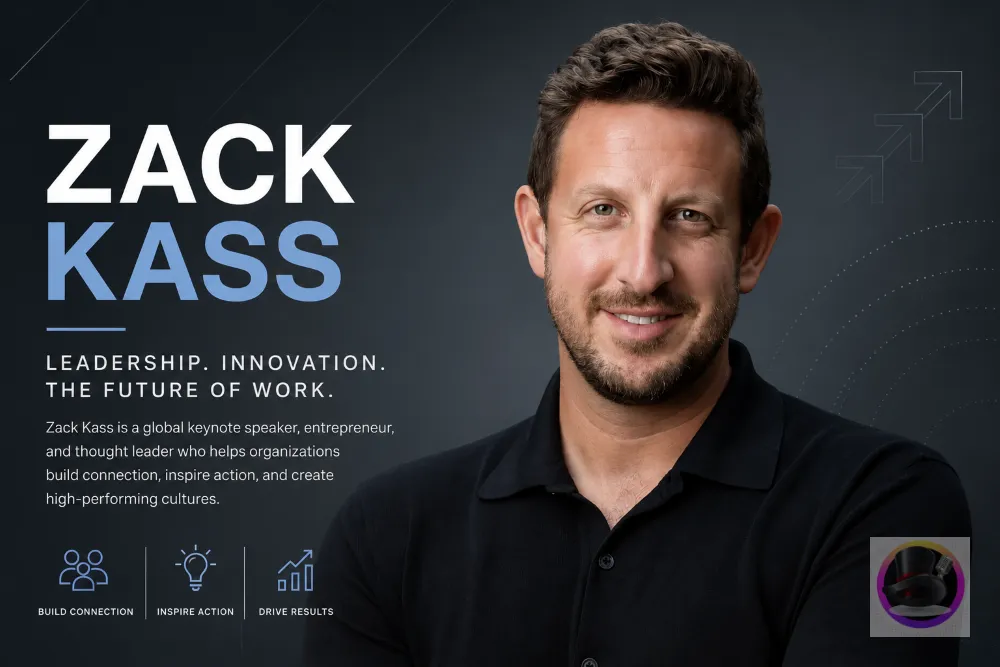
Zack Kass: AI Futurist and OpenAI Speaker
- Author: Speakers Inc
Read the news article
Zack Kass: The AI Futurist Who Believes the Future Is Brighter Than You Think
Most conversations about artificial intelligence begin with fear. Job losses. Algorithmic bias. Existential risk. The dominant narrative in boardrooms and conference halls has been one of anxiety, and that anxiety has a cost: organizations paralyzed by uncertainty, leaders unable to make decisive moves, workforces bracing for disruption they don’t understand.
Zack Kass has spent the last several years doing something radical in response. He walks into those same boardrooms and argues the opposite.
The real risk, according to Kass, isn’t AI moving too fast. It’s organizations moving too slowly.
As the former Head of Go-To-Market at OpenAI, Kass helped bring some of the most transformative AI technologies in history to a global market. He built the sales, solutions, and partnerships teams that turned cutting-edge research into real-world adoption. He has since sat in more than 500 boardrooms, delivered keynotes to over 300,000 people across five continents, and published a USA Today bestselling book arguing that we are not on the edge of a cliff. We are standing at the beginning of a renaissance.
For event planners and conference organizers searching for an AI keynote speaker who can cut through the noise, Kass offers something rare: genuine insider credibility paired with a message that leaves audiences energized rather than terrified.
From OpenAI to the Global Stage
Zack Kass joined OpenAI in January 2021, at a moment when the company was still largely known within AI research circles rather than across the global economy. Over the next two years, he led the go-to-market function that would help change that.
His role was not to build the technology. It was to make the technology legible, adoptable, and commercially viable for the organizations that needed it most. That meant translating the technical breakthroughs emerging from OpenAI’s research labs into practical strategies that Fortune 1000 companies, governments, and institutions could act on. It also meant understanding, firsthand, why adoption is so much harder than invention.
“The biggest barrier is no longer what technology can do, but what society is willing to accept.” — Zack Kass, BEYOND Expo 2025 AI Summit
That insight sits at the heart of everything Kass now does as a speaker and advisor. The bottleneck to AI progress is not engineering. It is human readiness: cultural resistance, institutional inertia, and the psychological weight of change at a scale most people have never encountered before.
What the OpenAI Years Actually Taught Him
The experience at OpenAI gave Kass something few AI commentators possess: a view from inside the machine. He watched as tools that researchers had been building for years became, almost overnight, the most discussed technology on the planet. He also watched organizations struggle to respond coherently.
That gap between what AI can do and what organizations are actually doing with it is the territory Kass now maps for his audiences. His keynotes don’t traffic in speculation. They draw on direct experience with the commercial deployment of AI at scale, which is a fundamentally different vantage point than that of the academic researcher or the tech journalist.
Since leaving OpenAI in January 2023, Kass has founded ZKAI Advisory and taken on a role as a Lui-Walton Technical Fellow at Conservation International, applying AI in service of environmental conservation and education. He also collaborates with the University of Virginia to study AI’s broader socio-economic impacts. The breadth of that work signals something important: for Kass, AI is not a single-industry story. It is a civilizational one.
The Next RenAIssance: A Counter-Narrative for the AI Age
In January 2026, Kass published The Next Renaissance: AI and the Expansion of Human Potential (Wiley), a book that quickly became a USA Today bestseller and drew praise from Kirkus Reviews as “a refreshing, well-crafted treatise on the many possible good things that thinking machines can bring.”
The central thesis is both simple and deliberately provocative: we are living through a moment comparable to the original Renaissance, a period when accumulated human knowledge and new tools combined to produce an explosion of creativity, discovery, and possibility. The difference is that this time, the catalyst is artificial intelligence.
Kass’s argument is not that AI is without risk. It is that fear has become the dominant frame, and fear is a terrible strategy.
The “Unmetered Intelligence” Concept
One of the most useful ideas Kass introduces is what he originally wanted to call the book’s core concept: “unmetered intelligence.” The premise is that intelligence, like electricity before it, is becoming a resource rather than a scarce commodity. As AI models grow more capable and simultaneously cheaper to run, the ability for any individual or organization to access high-quality cognitive assistance becomes less dependent on money, geography, or institutional affiliation.
The implications are significant:
- For individuals: access to expert-level guidance across medicine, law, finance, and education becomes democratized
- For organizations: the cost of knowledge work drops dramatically, but the premium on uniquely human skills rises
- For society: problems previously considered intractable, from drug discovery to climate modeling, become approachable at new speeds
Kass spoke with McKinsey’s Yuval Atsmon about the book’s core themes, noting that the future of work is “less about job loss and more about learning and adaptation.” That reframing is not naive optimism. It is a historically grounded argument: every major technological shift in human history has ultimately created more work than it displaced, even when the transition was painful.
The Human Premium
A concept that has resonated particularly strongly with business audiences is what Kass calls “The Human Premium.” As digital intelligence becomes commoditized through large language models, the things that remain distinctly human, physical presence, emotional connection, creative judgment, ethical reasoning, become more valuable, not less.
This is a counterintuitive position in a world where most AI discourse focuses on what machines will take from people. Kass inverts the frame: the more capable AI becomes, the more irreplaceable authentic human experience becomes. For leaders navigating workforce strategy, talent retention, and organizational culture in an AI-saturated environment, this is a genuinely useful lens.
What Zack Kass Speaks About
Kass has developed a suite of keynotes that address the questions most organizations are actually wrestling with, not the theoretical debates that dominate academic conferences. Each talk is built around the intersection of AI capability and human readiness, which is where the real decisions happen.
| Keynote | Core Question | Best For |
|---|---|---|
| The Next Renaissance | How will AI reshape industries, organizations, and human potential? | Leadership summits, all-hands events, industry conferences |
| Building in the Age of AI | How do you build high-performing teams and companies when AI is rewriting the rules of work? | Executive retreats, HR and talent conferences, business strategy events |
| The Pace of Change | Why is cultural and institutional resistance the real bottleneck to AI progress? | Technology conferences, innovation forums, policy and government audiences |
The Pace of Change: Why This Talk Matters Now
Of the three keynotes, “The Pace of Change” may be the most provocative and the most timely. Kass argues that throughout history, societies embraced innovation when it clearly made life better, fire, electricity, antibiotics, the internet. But something has shifted. With AI, the technology is advancing faster than the cultural and institutional frameworks needed to absorb it.
The result is a growing gap between what AI can do and what organizations are willing to do with it. Kass frames this not as a technology problem but as a leadership problem, one that requires frameworks for navigating resistance, rethinking institutional norms, and making decisions under genuine uncertainty.
This is the talk that turns an audience from passive observers of AI into active participants in shaping how it unfolds.
Across all three keynotes, audiences consistently report the same outcome: they leave with a clearer sense of what AI means for their specific context, and a more confident posture toward the decisions ahead. That practical clarity is what separates a Kass keynote from a TED-style overview of AI trends.
Why Kass Stands Apart in the AI Speaker Landscape
The market for AI keynote speakers has expanded rapidly. Every major conference now has a roster of technologists, consultants, and futurists offering their read on artificial intelligence. So the relevant question for event planners isn’t whether to book an AI speaker. It’s which AI speaker actually delivers something audiences can use.
Kass occupies a specific and defensible position in that landscape. Three things distinguish him from the broader field:
1. Operational Credibility at the Highest Level
Most AI speakers are either researchers who built the technology or consultants who advise on it from the outside. Kass is one of a very small number of people who led the commercial deployment of transformative AI at the organization that arguably did more than any other to bring AI into mainstream use. That is not a credential that can be replicated by studying the space. It comes from having been in the room when the decisions were made.
2. An Optimist Who Has Earned the Right to Be One
Techno-optimism is easy to dismiss when it comes from people with no firsthand experience of AI’s limitations and risks. Kass has that experience. He understands the alignment problem, the risks of bad actors, the “apprenticeship problem” in knowledge work, and the ways AI can widen inequality if deployed carelessly. His optimism is not the result of ignorance. It is a considered position, held in full awareness of the counterarguments.
That matters enormously for sophisticated business audiences. They don’t want cheerleading. They want someone who has thought seriously about the risks and still concludes that the opportunity is larger.
3. A Framework, Not Just a Forecast
Many AI speakers offer predictions. Kass offers frameworks: ways of thinking about AI adoption, workforce readiness, organizational culture, and the relationship between technological progress and human values that audiences can actually apply. His four principles for thriving in the age of AI give individuals and organizations a practical starting point, not just a sense of what is coming.
Key takeaway: Kass doesn’t just describe the AI landscape. He gives audiences the mental models to navigate it themselves.
For organizations looking to explore the full roster of AI and technology speakers available for their events, Speakers Inc maintains a curated directory of AI keynote speakers spanning a wide range of perspectives and expertise.
The Risks Kass Takes Seriously
A profile of Kass that only emphasized his optimism would be incomplete. Part of what makes him credible is his willingness to engage seriously with AI’s genuine risks, and to be specific about which ones he thinks matter most.
In his McKinsey Author Talks conversation, Kass identified three areas of legitimate concern:
- The alignment problem: The question of whether AI systems internalize human values is real, but Kass argues it is often poorly framed. The deeper issue is not that alignment is technically impossible. It is that there is no agreed-upon “North Star” for what aligned AI should look like, which means different systems may be aligned to competing values.
- The apprenticeship problem: In knowledge work, AI is automating much of the “grunt work” that junior employees historically did to develop their skills. In 20 years, Kass argues, we may see senior leaders who are highly efficient but lack deep understanding of the work being done beneath them, because they never had to do it themselves.
- Low and medium-resource bad actors: This is the risk Kass says concerns him most. Not nation-state cyberwarfare or science-fiction scenarios, but the use of increasingly capable AI tools by individuals or small groups to cause disproportionate harm. As AI becomes cheaper and more accessible, the barrier to malicious use drops.
What is notable about this list is what it excludes. Kass is not particularly worried about AI achieving consciousness, about machines deciding to harm humanity for their own reasons, or about the headline-grabbing existential scenarios that dominate popular discourse. He is worried about the mundane, structural, and human problems that AI will amplify. That distinction matters for business leaders trying to calibrate their own risk assessments.
Who Should Book Zack Kass
Kass is not the right speaker for every event. He is the right speaker for organizations that are serious about AI and want their audience to leave with a changed relationship to it, not just a list of tools to try.
He is particularly well-suited for:
- Leadership conferences and executive summits where C-suite audiences need a strategic frame for AI investment and workforce decisions
- Industry association events where members are
Who Should Book Zack Kass
Kass is not the right speaker for every event. He is the right speaker for organizations that are serious about AI and want their audience to leave with a changed relationship to it, not just a list of tools to try.
He is particularly well-suited for:
- Leadership conferences and executive summits where C-suite audiences need a strategic frame for AI investment and workforce decisions
- Industry association events where members are watching AI reshape their sector and need a credible, grounded perspective on what it means for them
- Internal all-hands or transformation events where organizations are rolling out AI initiatives and need to bring their workforce along, not just their leadership team
- Technology and innovation forums where the audience is already AI-literate and wants substantive engagement with the harder questions
He is also a strong fit for events where the audience has been exposed to a lot of AI doom content and needs a reset. The “Next Renaissance” framing is not naive, but it is genuinely different from most of what corporate audiences hear, and that difference creates energy in the room.
Kass has delivered keynotes across five continents, advises Fortune 1000 companies and governments, and brings the kind of stage presence that comes from having had the same conversation with 300,000 people in hundreds of different cultural and organizational contexts. He knows what lands, what provokes useful thinking, and how to read a room that came in skeptical.
For organizations exploring futurist and AI speakers for their next event, Kass represents one of the most distinctive voices available in the space today.
The Bigger Argument
Zack Kass: AI Futurist often ends his talks with a challenge that goes beyond business strategy. In a world where AI can increasingly handle cognitive tasks, the question of how people choose to spend their attention and energy becomes more urgent, not less. The risk he is most concerned about is not machines replacing humans. It is humans choosing not to show up fully because the machines make it easy not to.
“The way to avoid the trap,” he told McKinsey, “is to learn how to learn.”
That is not a technology message. It is a human one. And it is probably why his keynotes resonate across industries and geographies in a way that purely technical AI presentations rarely do. He is not talking about software. He is talking about identity, agency, and what it means to be a person in a moment of radical technological change.
For the organizations that get this right, Kass argues, the upside is extraordinary. Not just efficiency gains or cost reductions, but the chance to redirect human energy toward the things that only humans can do: building relationships, making ethical judgments, creating meaning, and leading with the kind of wisdom that no model can replicate.
That is the renaissance he is describing. And it is one worth showing up for.
Interested in booking Zack Kass for your next event? Contact Speakers Inc to discuss availability, keynote fit, and event logistics. Our team specializes in matching organizations with the right speaker for their specific audience and goals.
FAQ’s
Who is Zack Kass?
Zack Kass is an AI futurist, keynote speaker, consultant, and educator known for helping organizations understand and apply artificial intelligence in practical, business-focused ways. He is also the former Head of Go-To-Market at OpenAI and the author of The Next RenAIssance.
What did Zack Kass do at OpenAI?
At OpenAI, Zack Kass led go-to-market efforts that helped bring transformative AI technologies to market. His role focused on bridging the gap between advanced research and real-world adoption, giving him direct experience with how organizations can implement AI at scale.
What is Zack Kass’s main message about AI?
Zack Kass argues that AI is not primarily a threat, but a major opportunity for human progress. His work emphasizes that the biggest challenge is often organizational readiness, not the technology itself, and that responsible adoption can unlock innovation and productivity.
What topics does Zack Kass speak about?
Zack Kass speaks on AI strategy, innovation, the future of work, organizational change, and the relationship between technology and human potential. His keynotes are designed for leadership teams, conferences, and companies looking for a clearer, more confident view of AI.
Why book Zack Kass for an event?
Zack Kass brings rare credibility because he combines OpenAI leadership experience with a strong, accessible message about the future of AI. He is a strong fit for audiences that need strategic insight, practical takeaways, and a perspective that is optimistic without being naive.
Speaker Listing
No results available
Further articles you may enjoy:
- (18)
How to Find a Motivational Speaker for Your Employee Engagement Event Employee disengagement is not a morale problem. It is a revenue problem. Gallup’s 2025 State of the Global Workplace report found that only 21% of employees worldwide are engaged at work, a drop from 23% the previous year. In the United States alone, that […]
- September 3, 2026

- (28)
The Most In-Demand Keynote Speaker Topics for 2026 (And What They Mean for Your Event) Corporate event planners are facing a different booking landscape in 2026. Audiences are sharper, more skeptical, and less patient with speakers who deliver polished performances without real substance. Boards want keynotes that move strategy. Attendees want talks that help them […]
- September 2, 2026
- (25)
Best Motivational Speakers for a Nonprofit Annual Gala (and How to Choose the Right One) The keynote speaker at a nonprofit gala is not just a line item on the run-of-show. They are the emotional turning point of the evening. Get it right, and your guests leave inspired, connected to your mission, and ready to […]
- August 28, 2026

- (58)
Best Keynote Speakers for Tech Conferences in 2026 Introduction The best keynote speakers for tech conferences in 2026 bring more than a polished stage presence. They bring clear point of view, real-world credibility, and a talk that maps to the audience’s priorities, whether that means AI adoption, innovation strategy, digital transformation, cybersecurity, or leadership through […]
- August 18, 2026

- (21)
Top Finance Speakers for Financial Planning and Wealth Management Conferences Financial audiences are unforgiving. Advisors and wealth managers spend their days interpreting markets, navigating client psychology, and justifying every recommendation with data. When they sit down for a conference keynote, they expect the same rigor from the stage. A speaker who delivers generic inspiration or […]
- August 13, 2026

- (36)
Best Digital Transformation Speakers for Events: A Speakers Inc Shortlist for 2026 Most digital transformation events get the speaker brief wrong. The instinct is to book the most impressive futurist on the circuit, someone with a big TED Talk, a polished deck full of exponential curves, and a talent for making the future sound both […]
- August 10, 2026
- (26)
Best Futurist Speakers for Digital Transformation Events Digital transformation events carry a heavy burden. Attendees arrive skeptical, overwhelmed by buzzwords, and quietly wondering whether their organization is already behind. The keynote speaker you choose sets the entire tone. Either the audience leaves energized with a clear picture of what comes next, or they leave with […]
- August 4, 2026
- (43)
How to Evaluate an AI Keynote Speaker for Your Industry What Makes an AI Keynote Speaker Right for Your Industry? The AI speaker market has exploded. There are now hundreds of people positioning themselves as AI keynote speakers, and most of them will tell you they can speak to any audience. The reality is more […]
- July 30, 2026
No results available